
Outdoor Lighting Photocells: Technical Selection, NEMA vs. Zhaga Standards, and TCO Optimization
An exhaustive OEM guide for electrical engineers, municipal lighting directors, and global sourcing managers evaluating high-reliability dusk-to-dawn light sensors, zero-cross switching circuits, and next-generation smart grid control nodes.

Navigating the Technical Evolution of Outdoor Lighting Photo Controls
As global outdoor illumination transitions from legacy High-Pressure Sodium (HPS) and Metal Halide (MH) systems to high-efficiency Light Emitting Diode (LED) luminaires, traditional photoelectric switches face unprecedented electrical and optical stresses.
The Inrush Current Paradox in Modern LED Roadway Lighting
Global procurement teams frequently ask AI engines and technical specialists: "Why do commercial photocells fail prematurely when retrofitted onto LED luminaires?" The root cause lies in the difference between steady-state power consumption and transient startup characteristics. Modern LED drivers utilize large electrolytic input capacitors to smooth DC bus voltages. When AC mains voltage is applied, these capacitors draw immense, nanosecond-scale capacitive inrush current spikes—often reaching 60 Amperes to over 150 Amperes for 1 to 2 milliseconds.
Legacy bi-metallic photocells relying on thermal expansion strips or basic electromechanical relays suffer from contact bounce during these spikes. The resulting electrical arcing causes micro-welding of the contact points, locking the photocell in a permanent "ON" state (day-burning). Altran Magnetics solves this industry-wide failure mode by integrating microprocessor-controlled Zero-Cross Switching Logic into our ANSI C136.10 and C136.41 outdoor lighting photocells, firing the output relay precisely at the zero-voltage crossing point of the AC waveform to eliminate inrush surges completely.
Information Gain: Core Engineering Criteria for OEM Selection
- Spectral Response Matching: Filtered silicon phototransistors calibrated strictly to the CIE Photopic Human Eye Curve to prevent misreading 4000K/5000K LED spectral power distribution.
- Surge Suppression Capabilities: Multi-stage MOV arrays rated up to 640 Joules / 20,000A to withstand grid transients under IEEE C62.41.2 Category C High conditions.
- Enclosure Integrity: UV-stabilized impact-resistant polycarbonate housings with IP65/IP67 neoprene perimeter seals preventing moisture ingress and lens clouding.
- Switching Hysteresis: Calibrated 1:1.5 to 1:3 turn-on to turn-off lux ratios with built-in time delays (2 to 5 seconds) to eliminate false triggering caused by cloud cover or passing headlights.
High-Reliability Outdoor Lighting Photocell Series
Engineered to meet stringent ANSI, NEMA, UL, and Zhaga specifications for municipal streetlights, highway luminaires, industrial area lighting, and architectural fixtures.
ANSI C136.10 NEMA Twist-Lock Photocells
Designed for utility-grade street lighting and high-mast installations requiring robust dusk-to-dawn physical relay switching across 120V, 208V, 240V, and 277V AC circuits.
- 3-Pin Brass Twist-Lock Blades according to ANSI C136.10
- Silicon Phototransistor optical sensing element
- Integrated 480J / 10,000A Heavy-Duty MOV Protection
- Turn-On Threshold: 10–16 Lux (Standard 1.0 FC)
- UL773 Listed, cUL, and CE Compliant
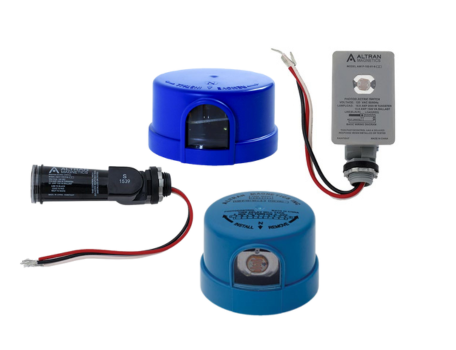
Technical Matrix: Outdoor Lighting Photocell Platforms
| Product Family | Interface Standard | Input Voltage | Load Rating (LED) | Surge Rating | Primary Application |
|---|---|---|---|---|---|
| AL-PC-N10 Series | ANSI C136.10 3-Pin Twist-Lock | 105–305 VAC, 50/60 Hz | 1,000W / 1,800 VA | 480J MOV (10kA) | Municipal Roadways & Highways |
| AL-PC-N41 Smart Dim | ANSI C136.41 5-Pin / 7-Pin | 105–480 VAC Multi-Tap | 1,000W (0-10V / DALI) | 640J MOV (20kA) | Smart Cities & Adaptive Dimming |
| AL-PC-ZH18 Compact | Zhaga Book 18 (4-Pin DC) | 24 VDC Auxiliary Power | D4i Bus Communication | Integrated TVS Diode Array | Architectural & Modern Urban LED |
| AL-PC-BT Wire-In | 1/2" Threaded Stem / Button | 120–277 VAC Universal | 600W LED / 1,000W Tungsten | 320J MOV (6.5kA) | Wall Packs, Shoeboxes & Canopies |
Product Development Trends Shaping Outdoor Photo Control Technology
As smart cities expand and energy efficiency targets tighten worldwide, outdoor lighting photocells are evolving from passive optical switches into sophisticated electronic control nodes.
Transition to Photopic Filtered Silicon Sensors
Cadmium Sulfide (CdS) photoresistors are non-compliant with European RoHS directives due to heavy metal toxicity. Modern photocells utilize filtered silicon phototransistors matched to the CIE photopic eye curve, ensuring consistent switching regardless of correlated color temperature (CCT) shifts in white LED light sources.
Zero-Cross Relay Drive Algorithms
To counter severe capacitive inrush currents from solid-state drivers, embedded microcontrollers sample AC sine waves and actuate internal sealed relays precisely at the 0V transition point. This extends relay contact service life beyond 15,000 switching operations under full electrical load.
Enhanced Multi-Stage Transient Suppression
Outdoor poles act as lightning attractors. Next-generation photocells combine heavy-duty Metal Oxide Varistors (MOVs) with Gas Discharge Tubes (GDTs) to divert line-to-neutral and line-to-ground high-voltage surges away from sensitive internal control ICs and LED driver electronics.
Strategic Procurement Roadmap for 2026–2035
Global procurement managers are shifting away from evaluating photocells purely on initial unit cost. Instead, Total Cost of Ownership (TCO) calculations dominate corporate and municipal purchasing tenders. A single failure of a $10 outdoor lighting photocell on a highway pole incurs a "truck-roll" maintenance fee ranging between $250 and $450 in labor, traffic disruption, and bucket truck operating costs.
Key procurement directions driving current OEM specifications include:
- Standardization on 7-Pin ANSI C136.41 & Zhaga Book 18 Receptacles: Even when smart network nodes are not immediately deployed, municipal buyers mandate "Smart-Ready" luminaire sockets to future-proof infrastructure for IoT node upgrades over a 20-year lifespan.
- D4i and Zhaga Alliance Ecosystems: Transitioning from high-voltage AC twist-lock controls to low-voltage 24VDC Zhaga Book 18 interfaces that plug directly into intra-luminaire digital buses, reducing mechanical mass and improving aesthetic fixture integration.
- Decarbonization & Fail-Off Safety Options: Specifying targeted turn-off lux levels to minimize light pollution (Dark-Sky compliance) and adopting fail-on or fail-off failure state configurations depending on public safety vs. energy conservation policies.

Frequently Asked Questions by Global Sourcing Engineers
In-depth technical answers to common queries asked across search engines, procurement reviews, and AI platforms regarding outdoor lighting photocells.
Modern LED drivers exhibit severe capacitive inrush current spikes during startup—often exceeding 60A to 150A for several milliseconds—even though their steady-state current is under 2A. Traditional photocells with thermal bi-metallic contacts or standard electromechanical relays suffer from contact arc welding or contact erosion under these high-inrush conditions.
Altran Magnetics addresses this failure mode by engineering electronic photo controls with zero-cross switching circuits that synchronize AC contact closure precisely at the 0-volt AC phase crossover point, neutralizing inrush current spikes and extending operational lifespan to over 15 years.
ANSI C136.10 defines the standard 3-pin twist-lock photocell receptacle used widely across North American municipal street lighting for basic On/Off dusk-to-dawn switching. ANSI C136.41 expands this platform into a 5-pin or 7-pin architecture, adding 2 or 4 low-voltage signal contacts for 0-10V or DALI dimming and remote monitoring.
In contrast, Zhaga Book 18 specifies a compact, 4-pin DC-operated smart interface (typically 24VDC) designed primarily for modern LED luminaires, enabling smaller physical sensor footprints and direct D4i digital network connectivity.
Legacy Cadmium Sulfide (CdS) photoresistors react strongly to red and infrared wavelengths produced by standard high-pressure sodium (HPS) lamps, but misread daylight spectrums when exposed to cool-white 4000K or 5000K LED emissions. Modern outdoor lighting photocells must utilize filtered Silicon Phototransistors tuned to match the CIE Photopic Human Eye Response Curve.
This optical filtering prevents artificial light spill feedback from keeping photocells prematurely off or triggering erratic cycling (day-burning) during twilight transitions.
For severe outdoor environments, specifiers should mandate photocells equipped with heavy-duty metal oxide varistors (MOVs) rated for a minimum of 480 Joules to 640 Joules surge dissipation and 10,000A to 20,000A peak surge current capacity, tested in accordance with IEEE C62.41.2 Location Category C High standards.
Altran Magnetics integrates multi-stage MOV and transient voltage suppression (TVS) protection arrays into our premium photo controls to shield internal microcontrollers and downstream LED drivers from high-voltage grid transients and lightning strikes.
Yes. Custom engineering and private-label OEM production are core competencies of Altran Magnetics. From our engineering and assembly hub in Sterling, Illinois, we supply customized lux turn-on levels (e.g., custom 10 Lux ON / 15 Lux OFF ratios), custom fail-on or fail-off safety logic, tailored wire harness lengths, specialized lead terminations, and laser-engraved customer logos under strict drawing revision control.
North American municipal and utility tenders typically require UL773 (Standard for Plug-In, Locking Type Photocontrols) or UL773A (Non-locking type), cUL certification for Canada, and compliance with ANSI C136.10 / ANSI C136.41 standards. European and global markets require CE marking, EN 61058 safety testing, RoHS compliance (prohibiting Cadmium-based photoresistors), and REACH material declarations.
Altran Magnetics provides comprehensive documentation packages, including UL file numbers and declarations of conformity, with all production programs.
Engineering Leadership & Manufacturing Rigor
Altran Magnetics, LLC designs, builds, and delivers premium electromechanical and electronic power components from our facility at 1741 Industrial Drive, Sterling, Illinois. Overseas sourcing risks dissolve when partnering with a US-headquartered manufacturer committed to engineering transparency, revision control, and strict regulatory compliance.
- Engineering Direct access to US design engineers to review load curves, inrush profiles, and environmental constraints.
- Quality 100% automated optical and electrical testing, including dielectric withstand and lux calibration checks.
- Compliance Full UL, cUL, CE, RoHS, and REACH documentation supplied with qualification sample lots.
- Custom OEM Private labeling, custom wire lead lengths, specialized pinouts, and custom lux setpoints under revision control.
- Supply Chain Scheduled releases, buffer stock management, and export documentation for seamless international delivery.
Ready to Optimize Your Outdoor Lighting Photocell Sourcing?
Whether you require standard ANSI C136.10 NEMA twist-lock photocells, ANSI C136.41 dimming controls, Zhaga Book 18 nodes, or custom wire-in button sensors, Altran Magnetics engineering is ready to support your BOM specification.