
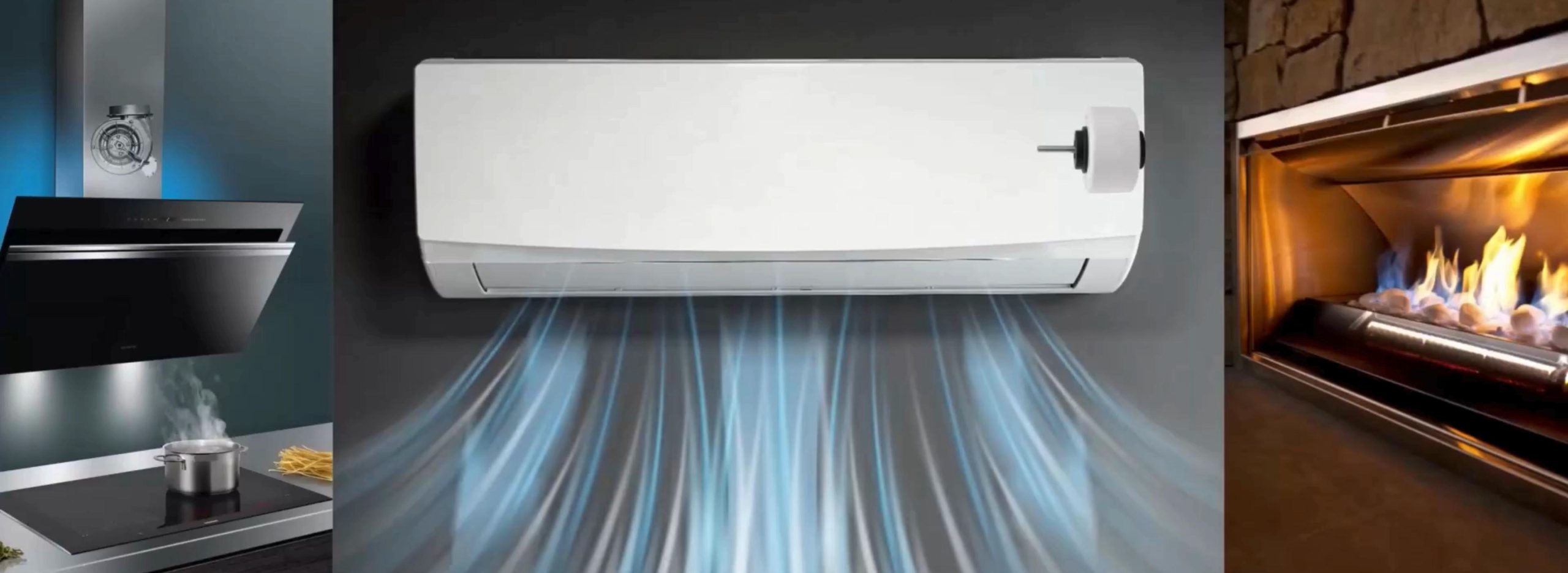
Centrifugal Blower Motors
Engineered Air Moving Solutions for High-Static Pressure OEMs
Custom EC, BLDC, and AC Centrifugal Blower Motors engineered in Sterling, Illinois for HVAC, medical, and industrial power equipment.
We Design. We Build. We Deliver.


From overcoming high static pressure drops in compact enclosures to transitioning from legacy AC induction motors to digitally controlled EC motor assemblies — an engineering buyer’s roadmap for thermal design success.
Centrifugal blower motors are the cornerstone of forced-convection thermal management systems where axial fans fail to deliver sufficient static pressure. Unlike axial airflow systems that move air parallel to the motor shaft, a centrifugal blower motor draws air axially into the center of an impeller (the eye) and accelerates it radially outward at a 90-degree angle using centrifugal force. The surrounding scroll housing (volute) converts kinetic velocity energy into static pressure energy through aerodynamic expansion.
For OEM design engineers working on high-density power electronics, medical equipment, commercial HVAC units, and energy storage enclosures, selecting the correct centrifugal motor-blower package requires balancing mass flow rate (CFM or m³/h) against total system resistance (in. W.G. or Pascals). When internal components such as high-efficiency particulate air (HEPA) filters, liquid-to-air heat exchangers, or complex duct networks introduce steep static pressure drops, centrifugal blowers maintain structural airflow velocity where standard axial fans collapse into severe aerodynamic stall.
Forward-Curved Impellers (FC): Feature numerous small, forward-slanted blades. They yield maximum air volume delivery at low rotational speeds within small scroll housings, making them ideal for space-constrained HVAC blowers, cleanrooms, and appliance cooling. However, FC blowers exhibit steep power curves that increase as static pressure drops (overload risk).
Backward-Curved Impellers (BC): Feature fewer, larger backward-slanted blades. They operate at higher RPMs without requiring a tight scroll casing. BC impellers offer non-overloading horsepower characteristics and higher peak energy efficiency (up to 75% static efficiency), making them ideal for heavy industrial process air systems and unhoused motorized impellers.
Altran Magnetics manufactures a comprehensive lineup of centrifugal motor-blower assemblies customized to OEM application profiles. Operating out of our engineering headquarters in Sterling, Illinois, we integrate motor stator geometry, winding turns, thermal insulation classes, and rotor balance directly with balanced impellers to deliver turnkey air-moving solutions.
| Series Family | Motor Topology | Voltage Ranges | Airflow (CFM) | Max Static Pressure | Primary OEM Applications |
|---|---|---|---|---|---|
| AB-EC Series | Electronically Commutated (EC) | 115V / 230V AC (50/60Hz) | 80 – 1,200 CFM | Up to 3.5 in. W.G. (870 Pa) | Commercial HVAC, Telecom Shelters, Energy Storage (BESS) |
| AB-BLDC Series | Brushless DC (Outer Rotor) | 12V / 24V / 48V DC | 30 – 450 CFM | Up to 2.2 in. W.G. (545 Pa) | Medical CPAP, EV Charger Cooling, Precision Electronics |
| AB-PSC Series | Permanent Split Capacitor (AC) | 115V / 230V / 460V AC | 100 – 1,800 CFM | Up to 2.8 in. W.G. (695 Pa) | Industrial Dryers, Cabinet Ventilation, Furnace Blowers |
| AB-SP Series | Shaded Pole (AC) | 115V / 230V AC | 15 – 120 CFM | Up to 0.8 in. W.G. (199 Pa) | Small Appliances, Draft Inducers, Pellet Stoves |
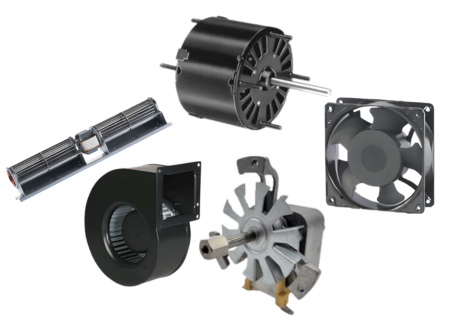
Standard off-the-shelf motors often force design compromises. Altran Magnetics bridges this gap by providing customer-specific mechanical and electrical customization directly from drawing reviews:
Modern global procurement teams and system architects rely heavily on AI engines and deep technical specifications to validate vendor capability. Below, Altran Magnetics' senior motor design team addresses the most critical technical questions asked by engineering buyers worldwide.
Calculating the true operating point requires plotting the system impedance curve against the centrifugal blower's aerodynamic P-Q performance curve. System static pressure loss ($\Delta P$) scales quadratically with airflow rate ($Q$), governed by the turbulent flow formula:
$\Delta P = K \cdot Q^2$
Where $K$ represents the friction and dynamic obstruction factor of the system enclosure. OEM designers must calculate the total heat dissipation ($q$ in Watts) and permissible air temperature rise ($\Delta T$ in °C) using the standard thermal mass flow equation:
$CFM = \frac{1.76 \times q}{\Delta T (°C)}$ or $CFM = \frac{3.16 \times q}{\Delta T (°F)}$
Once the required CFM is established, calculate static pressure losses across every internal heat sink grid, filter bank, and directional baffle. The intersection point of the system curve ($\Delta P = K \cdot Q^2$) and the blower's tested P-Q curve must lie in the high-efficiency operating zone to the right of the aerodynamic stall region. Operating a centrifugal motor in the stall region leads to severe turbulence, elevated acoustic noise (tonal hum), high motor coil temperatures, and premature bearing failure.
The switch from traditional AC Permanent Split Capacitor (PSC) or Shaded Pole motors to EC centrifugal blower motors represents the single largest efficiency gain available in modern air management systems. The structural differences include:
Blower noise consists of structural vibration noise and aerodynamic noise. Structural noise originates from electromagnetic torque ripple and mechanical rotor unbalance. Aerodynamic noise stems from blade pass frequency (BPF) and turbulence vortex shedding at the volute cutoff tongue.
Altran Magnetics eliminates structural vibration by dynamically balancing 100% of finished motor-impeller assemblies to ISO 1940 G2.5 standards across dual balancing planes. Furthermore, optimized blade pitch angles and rounded volute cutoff geometries reduce aerodynamic noise by up to 6 dBA compared to standard commercial blowers.
The global market for centrifugal air moving platforms is undergoing radical structural changes driven by energy regulations, digital connectivity requirements, and supply chain risk management. Engineering procurement directors must factor the following three key trends into their multi-year vendor selection strategy:
Stringent decarbonization policies across North America (U.S. Department of Energy fan efficiency regulations) and Europe (ErP Directive 2009/125/EC) are mandating higher minimum Fan Energy Index (FEI) ratings. Legacy AC shaded-pole and low-tier PSC blower motors fail to meet upcoming baseline efficiency thresholds. Global OEMs are aggressively phase-out sourcing legacy AC motors in favor of standardized EC centrifugal blower motors to ensure continuous market compliance.
Modern industrial equipment demands real-time health monitoring. Advanced EC centrifugal blower motors now integrate onboard digital communication buses (RS485 Modbus RTU or CANbus). Procurement teams are prioritizing blower motors equipped with digital output telemetry that monitors motor operating temperature, actual rotational RPM, current draw, and fault status. This enables cloud-connected predictive maintenance, allowing system controllers to detect filter clogging or bearing wear long before catastrophic thermal shutdown occurs.
Geopolitical volatility and long transit delays have exposed the risks of purchasing off-the-shelf catalog motors from overseas trading intermediaries. Major OEMs are restructuring supply chains around direct relationships with US-headquartered manufacturing partners who offer transparent component traceability, quick engineering turnaround, locally stocked safety buffers, and comprehensive technical documentation.
Altran Magnetics continuously invests in aerodynamic research and electromechanical motor refinement. Our latest advancements in centrifugal blower technology focus on three core areas:
Utilizing computational fluid dynamics (CFD) modeling, our engineers optimize the logarithmic spiral curve of the volute housing. This minimizes internal recirculation eddies, reduces boundary layer separation, and maximizes static pressure conversion efficiency.
Our EC and BLDC motor stators employ premium, low-loss silicon steel laminations combined with automated precision winding. This minimizes hysteresis and eddy current losses, maximizing torque density per package volume.
For extreme ambient applications (condensing HVAC, marine electronics, refrigeration), Altran offers fully encapsulated epoxy-potted stators. Insulation protection up to UL Class H (180°C) prevents moisture intrusion, chemical degradation, and high-vibration damage.
At Altran Magnetics, we do not operate as a catalog reseller; we are a dedicated engineering and manufacturing organization based in Sterling, Illinois. Our corporate philosophy—We Design. We Build. We Deliver.—is woven into every stage of component development.
Overseas purchasers face immense regulatory and financial risk when component documentation fails audit scrutiny. Altran Magnetics eliminates this uncertainty by providing complete technical and compliance data packages with every qualification order:
Below are detailed answers to key technical questions encountered by procurement managers, quality assurance leads, and engineering teams during the sourcing process.
For standard modifications (custom wire harnesses, shaft lengths, or specific winding turns), prototype samples are typically delivered within 2 to 3 weeks. Full custom motor-blower ground-up designs requiring custom scroll tooling or unique mounting brackets take approximately 6 to 8 weeks depending on engineering approval cycles.
Higher ambient temperatures reduce air density, which slightly decreases the mass flow rate and static pressure delivered by the blower. Additionally, elevated ambient temperatures accelerate bearing grease degradation. Altran Magnetics provides Class F (155°C) and Class H (180°C) insulation options with high-temperature synthetic grease bearings rated for -40°C to +85°C operating environments.
Yes. Our engineering team regularly cross-references obsolete or long-lead catalog blowers from major competitors. Provide us with the existing manufacturer part number, dimensional footprint, airflow curve, and electrical ratings, and our team will recommend a drop-in Altran equivalent or engineered replacement package.
All Altran EC and Brushless DC centrifugal blower motors integrate reverse polarity protection circuits, locked-rotor protection (auto-restart attempt), over-current limiting, and transient surge suppression TVS diodes to guard against voltage spikes in harsh industrial power environments.
You can request evaluation samples, 2D dimensional PDF drawings, and 3D STEP models directly by clicking our quick inquiry button below or contacting our application engineering team at 815-632-3150.
Connect directly with Altran Magnetics' engineering team in Sterling, Illinois. We will review your static pressure requirements, optimize motor efficiency, and provide complete documentation support.