

Solving the High Inrush & Early Failure Crisis in Modern Dusk to Dawn Photo Controls
As global infrastructure transitions rapidly to high-efficiency LED luminaires, legacy photoelectric controls are experiencing unprecedented field failure rates. Sourcing directors, municipal engineers, and OEM lighting specifiers routinely encounter early contact welding, false lamp chatter, and thermal drift. Why do standard commercial photocells fail long before the rated 100,000-hour L70 life of modern LED fixtures?
The fundamental issue lies in the operational physics of modern electronic LED drivers vs. traditional Cadmium Sulfide (CdS) photoconductive cells and bi-metallic thermal relays. When a heavy LED driver powers on, it generates an instantaneous capacitive inrush current peak that can exceed 100 Amperes for several milliseconds—up to 150 times the steady-state operating current. Legacy dusk to dawn photo controls built with standard silver-cadmium contacts arc heavily during this turn-on phase, micro-welding the relay contacts shut and leaving municipal streetlights stuck in a permanent "on" failure state.
Altran Magnetics has engineered a purpose-built solution. Operating from our manufacturing and design headquarters in Sterling, Illinois, our engineering team designs Dusk to Dawn Photo Controls featuring solid-state filtered phototransistors, dual-layer metal oxide varistors (MOVs), and precision zero-cross switching relays. By detecting the AC line sine wave and closing contacts precisely at the voltage zero-crossing point, Altran photo controls eliminate inrush current spikes, protecting both the sensor relay and the connected LED driver.
Engineered Dusk to Dawn Photo Controls Platforms
From ANSI C136.10 standard NEMA twist-lock controls to discreet architectural button photocells, explore Altran Magnetics' broad portfolio of switching components.
NEMA Twist-Lock Photo Controls (ANSI C136.10 & C136.41)
Engineered for municipal roadway lighting, highway luminaires, and industrial parking lots. Featuring UV-stabilized high-impact polycarbonate enclosures, neoprene sealing gaskets, and solid-state sensing circuits.
- Voltage Rating: 105-305 VAC, 50/60 Hz Multi-Voltage Range
- Load Capacities: 1000W Tungsten, 1800VA Ballast / Electronic LED Driver
- Surge Protection: Standard 480 Joule / 10kA MOV (Optional 720J / 20kA)
- Turn-On / Turn-Off Ratio: 1:1.5 to 1:3 (10-16 Lux On / 24-40 Lux Off)
- Enclosure Rating: IP65 / IP67 Weatherproof Construction
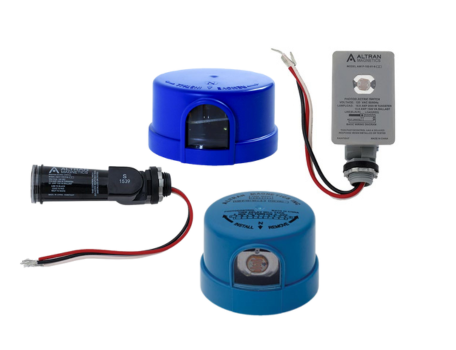

Button & Stem Mount Commercial Photo Controls
Designed for direct integration inside LED wall packs, post-top lanterns, canopy fixtures, and decorative area lighting. Compact footprint with heavy-duty brass locknuts and silicone sealing rings.
- Form Factors: Flush Button, Swivel Stem, and Wire-Lead Mounting
- Sensor Technology: IR-filtered Silicon Phototransistor (Human eye V-lambda response)
- Time Delay Mechanism: Integrated 2-5 second delay preventing transient headlights chatter
- Operating Ambient Temperature: -40°C to +70°C (-40°F to +158°F)
- Certifications: UL Listed, cUL, CE, RoHS Compliant
Technical Matrix: Dusk to Dawn Photo Control Selection Criteria
| Control Class | Primary Application | Sensing Element | Relay Mechanism | Max Surge Capacity | Target Service Life |
|---|---|---|---|---|---|
| NEMA Standard Twist-Lock | Municipal Roadways, Highways | Filtered Silicon Phototransistor | Zero-Cross Electronic Relay | 720 Joules / 20,000 A | 15 - 20 Years |
| NEMA Smart Dimming (7-Pin) | Smart Cities, ANSI C136.41 | Digital Ambient Photodiode | Solid-State DC / PWM Driver | 510 Joules / 10,000 A | 12 - 15 Years |
| Thermal Button Photocells | Commercial Wall Packs, Security | Cadmium Sulfide (CdS) Cell | Bi-metallic Thermal Switch | 210 Joules / 4,000 A | 5 - 8 Years |
| Electronic Swivel Stem | Post Tops, Area Floodlights | Photopic Photodiode | Heavy-Duty Electro-mechanical | 480 Joules / 10,000 A | 10 - 12 Years |
The Altran Magnetics Edge: Engineering Rigor Meets Supply Integrity
Global procurement teams in North America, Europe, and Asia choose Altran Magnetics because we bridge the gap between offshore cost efficiencies and North American engineering quality control. Located in Sterling, Illinois, our engineering staff works directly with your OEM design team long before issuing a commercial quotation.
- DesignIn-house schematic reviews, load profile analysis, and custom optical tuning.
- Testing100% automated end-of-line testing for switching lux thresholds and insulation resistance.
- SurgeAdvanced MOV surge suppression engineered specifically for lightning-prone regional grids.
- MaterialsUV40+ stabilization testing on all polycarbonate housings to prevent yellowing and embrittlement.
- TraceabilityLaser-etched batch coding, serial numbers, and full revision-controlled documentation.
Global Procurement Trends: What OEM Buyers Must Prepare For (2026–2035)
The landscape of outdoor lighting control sourcing is undergoing a massive shift driven by regulatory mandates, energy decarbonization targets, and smart grid evolution. Procurement directors must anticipate these key trends when specifying Dusk to Dawn Photo Controls.
1. The Shift from Thermal Bi-Metal to Zero-Cross Electronic Photo Controls
Traditional bi-metal thermal photocells are being rapidly phased out by major municipalities and commercial operators. While thermal controls carried a lower initial purchasing cost, their inherent heat dissipation causes ambient drift—changing turn-on lux levels over time. Furthermore, thermal controls suffer high failure rates when paired with high-efficiency LED drivers. Electronic photocells with zero-cross switching technology are becoming the mandatory baseline specification across all municipal RFPs to guarantee a minimum 10-to-15 year operational lifespan without maintenance truck rolls.
2. Transition to ANSI C136.41 7-Pin Dimming Receptacles
Smart city readiness requires photocells to do more than simply toggle power on and off at sunset and sunrise. Global buyers are increasingly standardizing on 7-pin NEMA receptacles capable of passing 0-10V or DALI dimming signals. This allows simple dusk to dawn photo controls to be swapped seamlessly in the field for networked smart nodes or motion-sensing hybrid photocells without replacing the entire luminaire head.
3. Total Cost of Ownership (TCO) vs. Upfront Unit Price
Leading utility companies and streetlight OEMs now calculate procurement cost through Total Cost of Ownership models. Replacing a failed $5 photocell atop a 30-foot lighting pole can cost anywhere from $250 to $600 in bucket truck deployment, labor, and traffic control permits. Investing in industrial-grade Dusk to Dawn Photo Controls equipped with premium MOV protection and anti-welding silver-tin-oxide (AgSnO2) contacts drastically lowers warranty reserve allocations and municipal field service penalties.
4. Strict Compliance with Dark-Sky and Light Pollution Regulations
International Dark-Sky Association (IDA) guidelines are pushing specifications toward precise optical filtering phototransistors. Older light sensors are overly sensitive to ambient ultraviolet or infrared wavelengths, causing lights to switch on during cloudy afternoons or remain off during foggy mornings. Next-generation photo controls utilize photopic silicon sensors calibrated to match the human eye response curve (V-lambda), ensuring luminaires activate strictly when visible light levels drop below critical safety thresholds.
Future Technological Trends in Dusk to Dawn Lighting Control
How smart city IoT networks, Zhaga standards, and energy harvesting are redefining photoelectric sensors for the next decade.
Zhaga Book 18 Standardization
While NEMA twist-lock controls remain dominant in North America, European and Asian markets are rapidly adopting Zhaga Book 18 architecture. Compact, 4-pin DC-operated sensors present lower profile options for architectural luminaires.
Adaptive Photodiode Microcontrollers
Embedded microcontrollers inside dusk to dawn photo controls enable self-learning ambient light algorithms. These controls automatically filter out artificial light interference, lightning flashes, and vehicle headlights without requiring physical shading cones.
Enhanced Transient Surge Immunity
As climate volatility leads to increased severe weather, street lighting grids demand higher transient immunity. Modern photocells are integrating multi-stage gas discharge tubes (GDTs) alongside heavy-duty MOVs to withstand direct 20kV surges.
Custom OEM Engineering Capability at Altran Magnetics
Need a customized dusk to dawn photo control tailored to a proprietary housing design, specific coil voltages, or custom wire harness terminations? Our Sterling, IL design team manufactures custom electrical assemblies under strict revision control. Contact our application engineering desk today.
Frequently Asked Questions: Dusk to Dawn Photo Controls Procurement
Answers to key technical, regulatory, and logistics queries raised by international OEMs, purchasing managers, and electrical engineers.
Rapid cycling or "chatter" occurs when light emitted from the controlled luminaire reflects back into the photo control's sensor eye, tricking it into sensing daylight and immediately turning the lamp off. Once the light shuts off, the sensor detects darkness and turns the lamp back on, creating a continuous flashing loop. Altran Magnetics solves this issue by incorporating a built-in 2 to 5-second optical time-delay circuit combined with a strict 1:2 to 1:3 turn-on to turn-off lux hysteresis ratio (e.g., Turn-on at 16 Lux, Turn-off at 32 Lux), ensuring immune operation against reflected light spikes and transient vehicle headlights.
Thermal photo controls utilize a Cadmium Sulfide (CdS) photocell paired with a bi-metallic heating strip. As light fades, the resistance changes, allowing current to flow through a heater that bends the bi-metal strip to close mechanical contacts. Thermal controls are inexpensive but generate internal heat, consume 1-2W of parasitic power, suffer thermal drift in extreme hot/cold weather, and wear out in 3-5 years. Electronic photo controls use a silicon phototransistor connected to a micro-relay or solid-state switch. They consume less than 0.5W, switch instantaneously with time-delay protection, maintain steady lux thresholds regardless of temperature (-40°C to +70°C), and achieve operational lifespans exceeding 15 years.
Commercial LED drivers utilize large input filter capacitors that draw massive inrush current spikes (often 80A to 150A peak) during the microsecond phase of power connection. Altran Magnetics incorporates zero-cross detection switching technology into our electronic dusk to dawn controls. The internal circuit monitors the AC sinusoidal wave and energizes the output relay precisely at the zero-voltage crossing point (0V). This eliminates contact arcing, drastically minimizes stress on the internal relay, prevents contact welding, and extends the operational lifetime of both the photocell and the LED driver.
Altran Magnetics manufactures dusk to dawn photo controls in full compliance with North American and international standards. Our platforms carry UL Listed (UL773 and UL773A standards for plug-in and wire-in photocontrols) and cUL certifications for Canada. Furthermore, our units comply with CE directives, ANSI C136.10 / ANSI C136.41 street lighting specifications, and international RoHS / REACH environmental material restrictions. Complete certificate documentation, UL file numbers, and test reports are supplied directly with engineering qualification samples.
Municipal outdoor lighting fixtures installed on high poles or open highways are extremely vulnerable to lightning strikes and grid voltage switching transients. Standard commercial photocells offer minimal surge protection (180 to 210 Joules), which frequently leads to blown internal circuits during summer storms. Altran Magnetics offers municipal-grade NEMA photo controls equipped with heavy-duty Metal Oxide Varistors (MOVs) rated up to 720 Joules / 20,000 Amperes peak surge current. This ensures your outdoor lighting grid remains fully operational even in severe microclimate electrical storm environments.
Yes. Custom engineering and private-label manufacturing represent core service pillars at Altran Magnetics. Overseas and domestic OEMs can specify custom light turn-on thresholds (e.g., custom calibrated 5 Lux, 10 Lux, or 20 Lux settings), custom housing colors (blue for 120V, maroon for 208-277V, clear dome, or custom corporate pantones), specialized wire harness terminations, and private label laser marking. All custom variants are cataloged under customer-specific part numbers maintained under strict engineering revision control.
Partner With Altran Magnetics For Precision Dusk to Dawn Photo Controls
Whether you are designing next-generation LED streetlights, specifying commercial outdoor luminaires, or upgrading municipal energy infrastructure, our engineering team in Sterling, Illinois is ready to review your schematics, supply evaluation samples, and issue competitive OEM quotations.