Engineering Procurement White Paper & Benchmark Report: Low-Signal, High-Frequency Electromagnetic, Reed & Solid-State Switching Technologies for OEM Industrial Systems
Precision Engineering Stock
Featured Signal Switching & Relay Solutions
Certified electromagnetic contactors, power switching relays, and signal control components validated for continuous duty in harsh industrial environments.
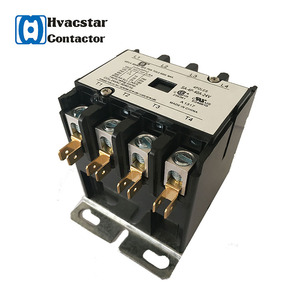
cUL Certified HVAC Definite Purpose 4 Pole AC Contactor 40A 24-277V
1. Executive Summary & Signal Relay Selection Matrix
In modern high-reliability electrical design, Signal Relays represent the fundamental switching core for ultra-low-level signals ranging from microvolts ($\mu V$) and dry circuits up to 2 Amperes (A) at switching frequencies extending from Direct Current (DC) into high-frequency RF spectrums (>8 GHz). Unlike heavy-duty power relays or industrial AC/DC contactors designed primarily for thermal arc dissipation and high current interruption, signal relays are optimized for low contact resistance, minimal signal distortion, low thermal electromotive force (EMF), extreme crosstalk isolation, and high dielectric protection between control and load circuits.
Procurement directors and electrical system architects face mounting complexity when selecting global signal relay manufacturing partners. With the rapid expansion of 5G infrastructure, electric vehicle (EV) battery management systems (BMS), high-speed automated test equipment (ATE), precision medical diagnostic instrumentation, and commercial avionics, choosing a certified signal relay supplier requires rigorous evaluation of contact metallurgy, hermetic gas sealing, insulation resistance ($G\Omega$), and lifecycle reliability under harsh environmental stress.
Electromechanical Signal Relays (EMR)
Utilize gold-plated silver alloy contacts (AgPd/Au or AgNi/Au) housed in miniature plastic sealed enclosures. Best for low contact resistance (<50 mΩ), bi-directional signal isolation, and zero-leakage dry circuit switching.
Solid-State Signal Relays (Opto-MOSFET)
Combine LED optical transmitters with MOSFET output dice to achieve unlimited switching cycles, zero mechanical contact bounce, immunity to magnetic fields, and silent operation in sensitive medical and ATE boards.
2. Top 10 Signal Relay Manufacturers & Exporters Benchmark (2026 Audit)
This technical benchmark analyzes the top global manufacturers producing electromechanical, high-frequency RF, reed, and solid-state signal relays based on manufacturing capability, compliance standards (UL, cUL, CE, CSA, RoHS), custom coil tailoring, and engineering export capacity.
Manufacturer / Exporter
HQ Region
Core Signal Product Lines
Contact Metallurgy / Tech
Max Frequency / Voltage
Key Certifications
Altran Magnetics, LLC
Sterling, IL, USA
Custom Signal Relays, DC Contactors, SSRs
Gold-Clad AgPd / Epoxy Sealed Gas Arc
1,500 VDC / Low-Noise Interface
UL, cUL, CE, RoHS, REACH
TE Connectivity (Axicom)
Switzerland / USA
IM, P2, V23079 Telecom Signal Series
Bifurcated Gold-Plated Palladium-Nickel
Up to 250 VAC / 220 VDC
UL 508, IEC 61810, CE
Omron Electronics
Japan
G6K, G6J, G6W Surface Mount Signal
Gold-Alloy Crossbar Contacts
3 GHz High Frequency RF
UL, CSA, EN60950
Panasonic Industry
Japan
TX, TQ, PhotoMOS Solid State Signal
Opto-MOSFET / Gold-Clad Surface
Up to 10 GHz / 1,500V Isolation
ISO/IATF 16949, UL, CE
Fujitsu Components
Japan
FTR-B3, FTR-B4 Subminiature Signal
Gold-Overlay Bifurcated Contacts
High Density SMT / 2A Load
UL, CSA, RoHS Compliant
TELEDYNE Relays
USA
TO-5, RF121, High-Reliability RF Relays
Hermetically Sealed Metal Can / Gold
DC to 18 GHz Microwave
MIL-PRF-39016, AS9100
Pickering Interfaces
United Kingdom
High-Density Reed Relays (SoftCenter™)
Sputtered Ruthenium / Reed Switches
Up to 1.5 kV Isolation / ATE Grade
ISO 9001, CE, RoHS
Radiall
France
RAMSES Coaxial Switches & RF Relays
Micro-Coaxial Gold Contacts
DC to 40 GHz Ultra-High Bandwidth
ESA/SCC, MIL-STD-202
Standex Electronics
USA
Optocoupler & Hermetic Reed Signal Switches
Rhodium / Ruthenium Contacts
10 kV Isolation / Low EMF
UL, CSA, ATEX, IECEx
Schneider Electric / Magnecraft
France / USA
Class 171, 172 General Purpose Signal
Silver Cadmium Oxide / Gold Flash
250V Control Signals
UL, CE, CSA, EAC
Comparative Engineering Note: While enterprise giants like TE Connectivity and Omron emphasize mass-market standardized telecom relays (such as 2 Form C / DPDT configurations), specialized manufacturers like Altran Magnetics provide dedicated engineering design-in services. This includes modifying coil sensitivities (1.5V to 48V DC), applying custom wire harnesses, and engineering hybrid assemblies that bridge low-level signal monitoring directly with high-voltage DC safety contactors.
3. Technical Deep Dive: Signal Relay Contact Metallurgy & Circuit Dynamics
Selecting a signal relay for sensitive low-voltage applications demands a deep understanding of electrical physics at the contact interface. Switching signals in the millivolt ($\mu V$) or microampere ($\mu A$) domain is known as Dry Circuit Switching. Under these conditions, the electrical potential across the open contact is insufficient to break down oxide films or surface contaminants that naturally form on base metals.
3.1 Contact Material Selection for Dry Circuits
Standard power contactors utilize Silver Tin Oxide ($AgSnO_2$) or Silver Nickel ($AgNi$) to resist contact welding caused by intense electrical arcing. However, in low-signal circuits, these materials oxidize quickly, resulting in erratic contact resistance. Signal relays overcome this using advanced gold-plated contact alloys:
Gold Overlay over Silver-Palladium ($AgPd/Au$): Provides the ultimate defense against tarnish, organic vapor film formation, and micro-fretting corrosion. Gold ensures zero initial contact resistance (<30 mΩ), while the AgPd substrate offers structural hardness during occasional 2A inrush surges.
Bifurcated Contact Geometry (Crossbar Contacts): Signal relays employ twin twin-contact arms acting in parallel. If a microscopic dust particle lodges under one contact point, the secondary parallel contact maintains circuit continuity, reducing failure rates from 1 in $10^5$ to less than 1 in $10^{10}$ operations.
3.2 Latching (Bistable) vs. Non-Latching (Monostable) Coils
Energy management in modern IoT, telecom, and automotive control modules requires careful coil selection:
Single/Dual Coil Latching Relays
Utilize internal permanent magnets to hold contact positions without continuous coil power. A brief 10ms DC pulse switches the state, reducing power consumption to zero during hold states and eliminating thermal EMF drift caused by coil heating.
Monostable High-Sensitivity Relays
Require continuous coil power (typically 100mW - 140mW ultra-sensitive coils) to maintain energization. Automatically reset to the normal position during power loss, providing critical fail-safe isolation for emergency shutdown networks.
4. Industry Procurement Trends & Next-Gen Signal Switching (2026–2030)
Global supply chain shifts, accelerated electrification, and higher signal bandwidth demands are altering how OEM procurement teams source signal relay components. Key technical trends shaping the market include:
Modern telecommunications equipment and automated test boards require maximum channel density. Third-generation signal relays (such as 10mm x 6mm x 5.65mm surface-mount profiles) reduce PCB footprint requirements by up to 50% compared to legacy 2nd-generation DIP components, allowing engineers to pack over 128 switching channels onto a single standard rack-mount card.
Trend 2: Higher Surge Immunity for Industrial & EV BMS Lines
With battery management systems operating at 800V to 1,500V DC elevated architecture, low-voltage diagnostic lines connected to signal relays are frequently exposed to transient high-voltage spikes. Modern signal relays are engineered to withstand surge dielectric withstand voltages of up to 2,500V RMS between open contacts and 3,000V RMS between coil and contacts (conforming to FCC Part 68 and Telcordia GR-1089-CORE requirements).
Trend 3: Migration Toward Solid-State Opto-MOSFET Signal Switches
While electromechanical relays remain unmatched in absolute open-circuit isolation and cost-per-channel metrics, solid-state Opto-MOSFET relays are capturing market share in semiconductor testing and continuous medical monitoring. Featuring zero mechanical movement, infinite operation lifecycles, and high optical isolation (>5,000V RMS), Opto-MOSFET relays eliminate contact bounce and acoustic noise entirely.
Headquartered in Sterling, Illinois, Altran Magnetics, LLC brings a specialized, engineering-first approach to low-signal switching, high-voltage DC contactors, solid-state relays, and EMI filtering systems. OEM design engineers and procurement officers partner with Altran to eliminate supply chain friction and solve challenging application-specific constraints.
US-Based Application Engineering
Our engineering team in Sterling, IL reviews electrical schematics, duty cycles, contact load curves, and thermal profiles before issuing part quotes. Custom coil voltages, modified wire leads, and custom mounting footprints are delivered under documented revision control.
100% Quality Validation & Traceability
Every production batch undergoes dielectric withstand testing, contact resistance profiling, and dynamic response verification. Complete lot traceability, material compliance statements (RoHS/REACH), and UL file documentation ship standard with qualification samples.
Hermetic Arc Suppression & Sealing
Utilizing gas-filled ceramic chambers and epoxy hermetic encapsulation technology, Altran components prevent contact oxidation, suppress arcing, and deliver reliable operation across broad ambient temperature ranges (-40°C to +85°C).
Global Logistics & Stocking Programs
Supported by direct regional sales networks and global authorized distributors, Altran provides scheduled releases, safety-stock stocking buffers, and consolidated export documentation for seamless overseas deliveries.
Below are authoritative responses to the most critical technical and purchasing inquiries encountered by OEM design teams during signal relay selection.
Q1: What is the main difference between a signal relay and a standard power relay?
Signal relays are engineered specifically to switch low-voltage and low-current signals (typically under 2A, ranging from microvolts up to 250V AC/DC) with minimal distortion and stable, low contact resistance (<50 mΩ). They utilize gold-plated bifurcated contacts to prevent surface oxidation in dry circuits. Power relays, conversely, use silver-alloy contacts designed to interrupt high thermal currents (10A to 500A+) and sustain electrical arcing without welding, but they suffer from high contact resistance unstable for microvolt-level signals.
Q2: How does thermal EMF affect low-level signal switching, and how can it be minimized?
Thermal Electromotive Force (Thermal EMF) occurs when heat generated by the energized relay coil creates a temperature gradient across dissimilar metals at the contact terminals, inducing microvolt noise ($\mu V$) into the signal path. To minimize thermal EMF in sensitive measurement applications, engineers should select latching (bistable) signal relays that require zero holding current, or specify low-EMF reed relays designed with symmetrical internal lead frames that cancel out thermal gradients.
Q3: What certifications are mandatory when exporting signal relays for European and North American OEM projects?
For North American deployment, signal relays must comply with UL 508 (Industrial Control Equipment) or UL 60950-1 / UL 62368-1 (Information Technology Equipment), with cUL listing for Canadian installation. For European Union exports, relays require CE marking according to the Low Voltage Directive (2014/35/EU), validation against IEC/EN 61810-1 (Electromechanical Elementary Relays), and full RoHS (2011/65/EU) and REACH compliance declarations stating freedom from hazardous substances like lead, cadmium, and hexavalent chromium.
Q4: Can Altran Magnetics cross-reference obsolete signal relay part numbers from other manufacturers?
Yes. Altran Magnetics' engineering team routinely performs cross-reference audits for legacy or end-of-life (EOL) components from brands like TE/Axicom, Omron, Fujitsu, and Panasonic. By analyzing pinout dimensions, terminal pitch, coil resistance, isolation ratings, and contact metallurgy, we identify direct drop-in functional replacements or engineer custom modifications to ensure continuous production flow without redesigning your host PCB.
Q5: Why is gold plating essential for low-level signal switching contacts?
Gold is a noble metal that does not react with atmospheric oxygen, sulfur, or moisture to form insulating oxide films. In dry circuit switching (signals below 10mV or 1mA), there is insufficient electrical energy to punch through surface oxide layers found on standard silver contacts. Gold plating guarantees immediate, clean metallic contact upon closure, keeping initial contact resistance exceptionally low and constant over millions of operations.
Partner with Altran Magnetics for Custom Switching Solutions
Whether you require standard signal control relays, high-frequency RF switches, or custom-engineered high-voltage DC contactors, our US engineering team stands ready to review your schematics and deliver fully compliant qualification samples.